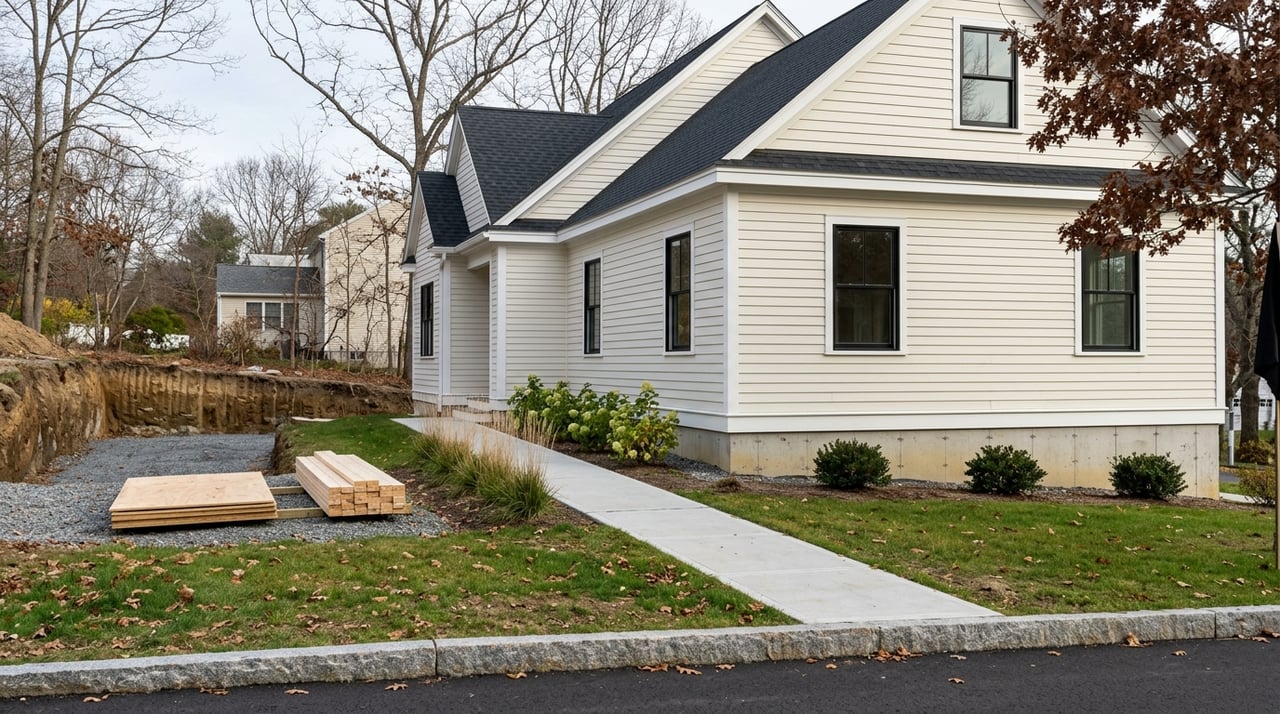
If you have been watching Wellesley real estate, you may have noticed something curious: many of the town’s “new construction” homes are not built on empty land at all. They are built in place of older houses, often on long-established lots in existing neighborhoods. If you are buying, selling, or evaluating a property with rebuild potential, understanding how this works can save you time, money, and surprises. Let’s dive in.
Why teardowns are so common in Wellesley
Wellesley is largely a replacement-housing market, not a market defined by large new subdivisions. According to the town’s FY2026 tax classification data, Wellesley has 7,319 single-family parcels and only 221 vacant land parcels. That imbalance helps explain why teardown and rebuild activity remains a recurring part of the local market.
The age of the housing stock matters too. Wellesley’s June 2025 draft Strategic Housing Plan says most homes in town were built before 1960, including 35% built in 1939 or earlier and 23% built from 1940 to 1959. Only 18% of the housing stock was built in 2000 or later, and 12% has been built since 2010.
That creates a common local pattern. Instead of finding open land, buyers and builders often look for older detached homes on lots that may support a larger replacement home under current rules. In practical terms, the lot is often the real opportunity.
How replacement housing shapes the market
One of the clearest signs of this trend comes from the town’s own housing data. The Strategic Housing Plan says Wellesley’s single-family housing stock increased by only 95 homes between 2003 and 2025, even though assessor records show more than 1,200 single-family homes were built during that period. The town interprets that gap as evidence that many newer homes replaced older ones on the same lots.
The same report notes that about 30% of demolitions over the last five years occurred on lots larger than half an acre. That does not mean only large lots matter, but it does show why bigger parcels often attract attention in a teardown conversation.
You can also see this activity across established parts of town. Current listing snapshots point to replacement-housing demand in areas commonly referred to as Wellesley Farms, Cliff Estates, Wellesley Hills, Poets Corner, and Standish Estates. These are market labels, not zoning categories, but they help describe where buyers are often seeing new-build inventory.
What zoning means for a teardown lot
Wellesley’s zoning map divides residential land into districts based on lot area. These districts include 10,000, 15,000, 20,000, 30,000, and 40,000 square feet. In Single Residence Districts, one-unit dwellings are allowed, and accessory dwelling units may also be allowed if they meet Section 5.13 requirements.
Lot size is only one part of the picture. Frontage, front setbacks, and other yard standards vary by district and sometimes by the age of the lot. The yard regulations show frontage ranging from 60 feet to 200 feet and front setbacks typically ranging from 30 to 40 feet.
There is another important point for buyers and sellers: the bylaw says there cannot be more than one dwelling on a lot. That is one reason many Wellesley teardown projects result in a single larger replacement home rather than multiple new homes on one parcel.
The permit process is layered
A teardown in Wellesley is rarely just a simple buy-and-build scenario. Before a building permit can be issued for a new one- or two-family dwelling, or for some major reconstructions and additions, the Planning Board must certify the adequacy of the way serving the lot. On older streets and private ways, this can become an early and important checkpoint.
Height rules also shape what gets built. While height is generally capped at 45 feet or three stories, one-unit, two-unit, and townhouse buildings permitted on or after November 5, 1996 are limited to 36 feet. That helps explain why many newer homes in Wellesley stay within familiar local proportions instead of pushing much taller forms.
For larger homes, the review process becomes more detailed. A project may need to move through demolition review, large house review, design review, tree protection review, and in some cases historic district or neighborhood conservation requirements. The sequence and timing can affect both cost and closing strategy.
When Large House Review applies
Large House Review is one of the most important checkpoints for larger replacement homes in Wellesley. It applies to new one-unit dwellings above specific size thresholds based on zoning district.
Those thresholds are:
- 3,600 square feet in the 10,000-square-foot district
- 4,300 square feet in the 15,000-square-foot district
- 5,900 square feet in the 20,000-square-foot district
- 7,200 square feet in the 30,000- and 40,000-square-foot districts
Some alterations can also trigger review if they increase the size of the home by more than 10%. The standards focus on landscape, building scale, lighting, open space, drainage, and circulation. In plain English, the town is looking closely at how a large new home fits its site and surrounding streetscape.
Demolition review can affect timing
If an owner plans to demolish more than 50% of a dwelling, Wellesley requires an Eligibility Notice first. Homes built on or before December 31, 1949 can be deemed eligible for review. If a property is found to be preferably preserved, demolition permits can be delayed for up to 12 months.
That timing issue is a major reason teardown deals need careful planning. The town states that the demolition review process is intended to happen before the demolition permit application, after utilities have been disconnected. For buyers, that means your expected construction start date may not be as simple as the closing date.
Tree protection and historic overlays matter too
Tree protection is another factor that can shape budget and schedule. Section 5.10 applies to demolition of structures with a footprint of 250 square feet or more, construction on vacant lots, and projects that increase an existing footprint by 50% or more.
Historic and conservation rules can add another layer. Wellesley has the Cottage Street Historic District, five single-building historic districts, and the Denton Road Neighborhood Conservation District, with another proposed on Standish Road. The town notes that neighborhood conservation districts were authorized in response to the increasing pace of demolitions in the early 2000s, and these districts rely on design guidelines rather than dimensional zoning standards.
For a buyer or seller, this means that two properties with similar lot sizes may not have the same redevelopment path. A property’s district, review triggers, and site conditions all matter.
What new construction looks like in Wellesley
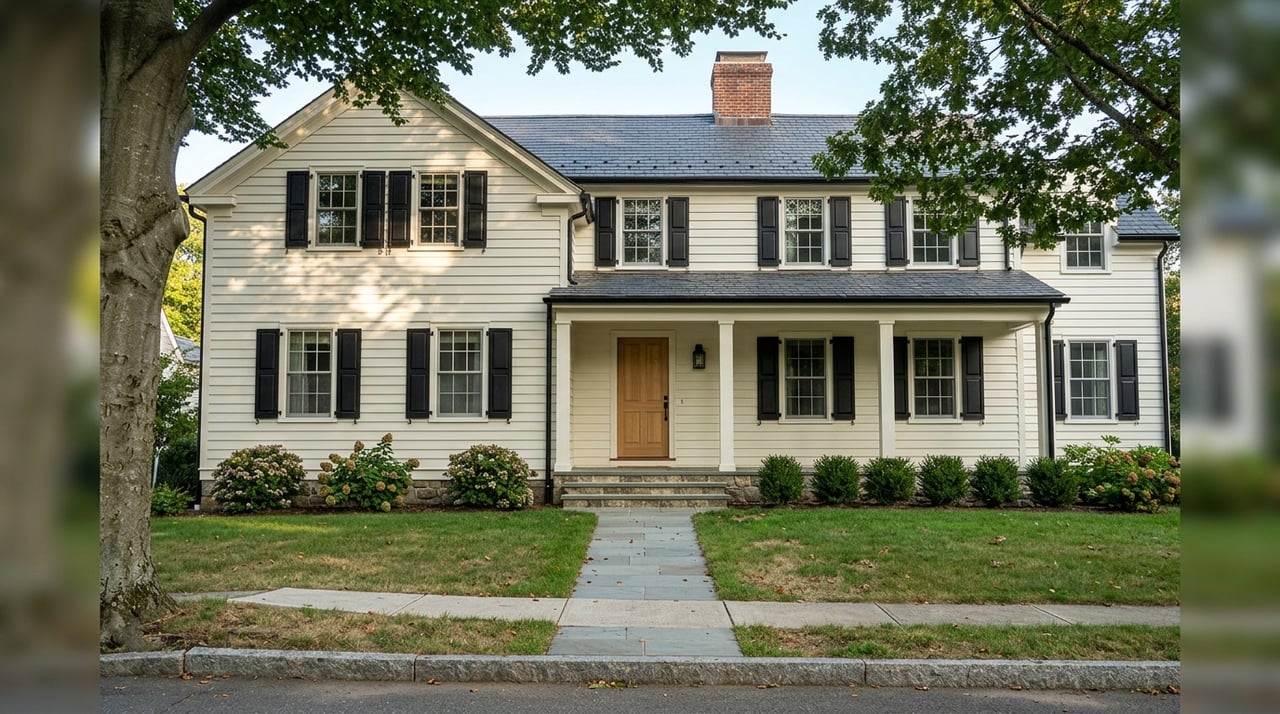
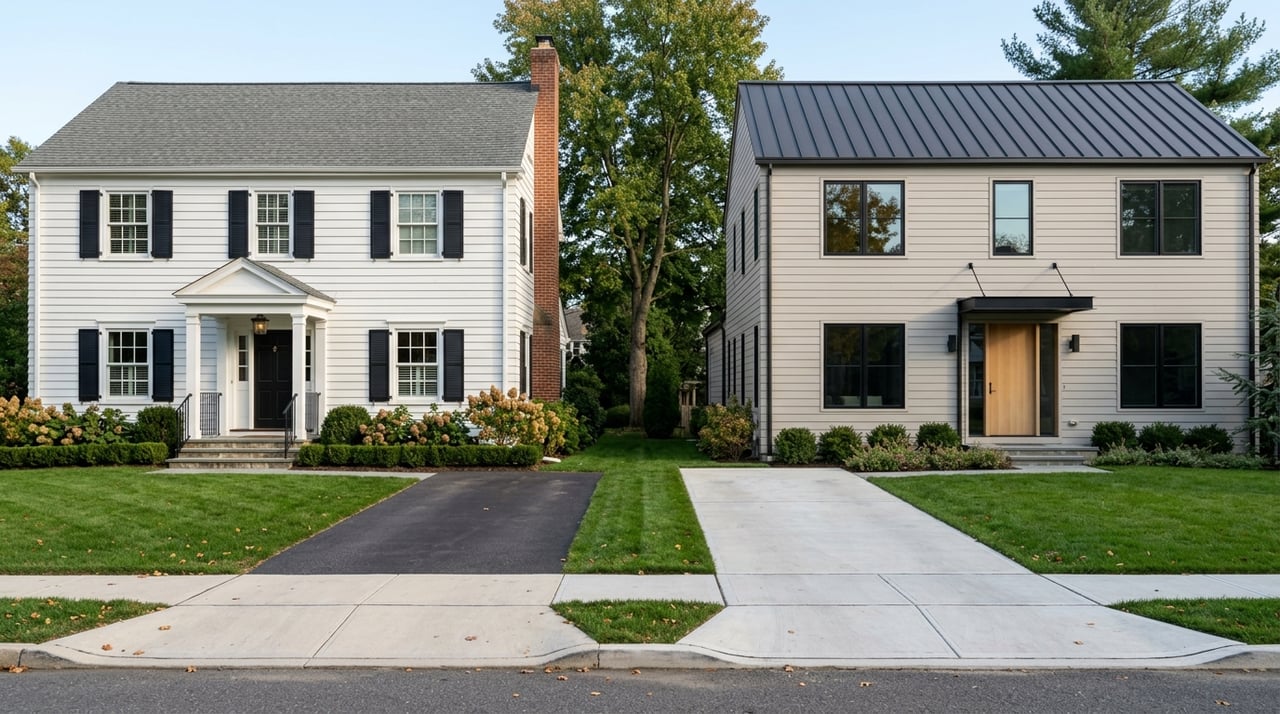
Wellesley’s newer homes usually do not ignore their surroundings. The Design Review Board is directed to consider landscaping, terrain, neighboring scale, height, façade rhythm, materials, roof slopes, and sustainable design. That framework helps explain why newer homes often aim for compatibility with the streetscape rather than a dramatic visual break.
The town’s Historic Preservation Design Guidelines point to Colonial Revival and other early twentieth-century residential styles as important local precedents. As a result, many new homes read as updated New England architecture rather than sharply contrasting infill.
Current listings reinforce that pattern. Examples include traditional colonial farmhouse styling, transitional design, custom colonials, and homes with open floor plans and higher-end finishes. Common features include front porches, mudrooms, open kitchens, coffered ceilings, custom millwork, and larger garages.
Site planning is part of the value
In Wellesley, the house itself is only part of the new-construction appeal. Site planning often emphasizes usable outdoor space, especially flat yards, pool-sized lots, covered porches, and rear-yard amenities. That matches the town’s review standards, which place weight on open space, circulation, and landscape preservation.
This matters when you compare a teardown candidate with a move-in-ready existing home. A well-positioned lot with strong outdoor utility may support a very different end product than the current structure suggests. For sellers, that can affect how the property should be marketed. For buyers, it can reshape what you are really paying for.
New construction pricing in Wellesley
Pricing for Wellesley single-family homes sits broadly in the low-to-mid $2 million range, based on recent town and portal data. The town’s June 2025 draft plan reports a 2024 median single-family sale price of $2,103,500. Homes.com’s 12-month snapshot shows a median sale price of $1,955,500 overall and $2,462,500 for single-family homes.
Those figures are not identical datasets, so it is better to think of them as a pricing band rather than one exact market number. New construction generally sits at the premium end of that range.
Realtor.com currently shows a median listing price of $2,400,000 for new construction homes in Wellesley, with 18 new-construction homes on the market and an average of 22 days on market. Active examples show how wide the spread can be, from a 2026-built two-bedroom condo at $1.498 million to single-family new builds listed at $2.645 million, $2.89 million, and $3.5 million. A recently completed new build at 38 Old Farm Road sold for $5 million and sits on 0.58 acres.
What buyers should pay attention to
If you are considering new construction or a teardown opportunity in Wellesley, the biggest questions usually go beyond finishes and floor plans. You need to understand the lot, the review path, and the likely timeline.
A few practical items to evaluate early include:
- Zoning district and lot dimensions
- Frontage and setback constraints
- Adequacy of the way serving the lot
- Large House Review thresholds
- Demolition review eligibility
- Tree protection requirements
- Historic district or neighborhood conservation district status
The main risks for buyers are often approval uncertainty, carrying costs, and timeline extensions while the project moves through local review. A property that looks straightforward at first glance may require much more due diligence than a conventional resale.
What sellers should understand about teardown value
If you own an older home in Wellesley, your property value may be influenced by more than the home’s current condition. In some cases, the lot size, zoning district, streetscape fit, and probable builder path can matter just as much, if not more.
That does not mean every older home is a teardown candidate. It does mean that positioning the property correctly is essential. A seller benefits from understanding whether the likely buyer is a homeowner looking for a move-in-ready house, a buyer considering a major renovation, or someone focused on replacement potential.
In a market like Wellesley, smart pricing and marketing start with the site’s real redevelopment story. That is where local knowledge and construction fluency can make a real difference.
Why local strategy matters in Wellesley
Wellesley’s rules are not simply obstacles to new construction. In practice, they are structured to support design quality, landscape preservation, and neighborhood character while still allowing substantial replacement housing activity.
That is why successful projects in town often blend updated layouts and luxury finishes with familiar New England forms and carefully scaled massing. If you are buying, selling, or evaluating a property for redevelopment, the goal is not just to identify potential. It is to understand how that potential aligns with the town’s actual review framework.
Whether you are weighing a teardown candidate, planning a future sale, or comparing new construction to an existing home, a clear local strategy can help you make faster and better-informed decisions. If you want expert guidance on Wellesley properties, lot potential, or new-construction opportunities, connect with The Boston ONE Team | SERHANT..
FAQs
What makes teardowns common in Wellesley real estate?
- Wellesley has far more older single-family homes than vacant lots, so much of its new construction comes from replacing existing houses rather than building on open land.
What is Large House Review in Wellesley?
- Large House Review is a local review process for certain larger one-unit dwellings, with square-footage thresholds based on zoning district and standards focused on scale, landscape, drainage, lighting, and circulation.
Can demolition delays happen for older homes in Wellesley?
- Yes. If more than 50% of a dwelling will be demolished and the home was built on or before December 31, 1949, it may be reviewed and could face up to a 12-month demolition delay if found preferably preserved.
Do all teardown projects in Wellesley face the same approval process?
- No. The process can vary based on zoning, lot conditions, way adequacy, tree protection triggers, historic district status, neighborhood conservation rules, and whether the project triggers Large House Review.
How much do new construction homes cost in Wellesley?
- Recent data place Wellesley single-family pricing broadly in the low-to-mid $2 million range, with new construction generally at the premium end and some homes listed or sold well above that depending on lot, size, and finish level.
Can an accessory dwelling unit be an alternative to a teardown in Wellesley?
- In some cases, yes. Wellesley allows accessory dwelling units in certain situations, but they must remain subordinate to the main home and meet local rules for size, design, entrances, stairs, and height.