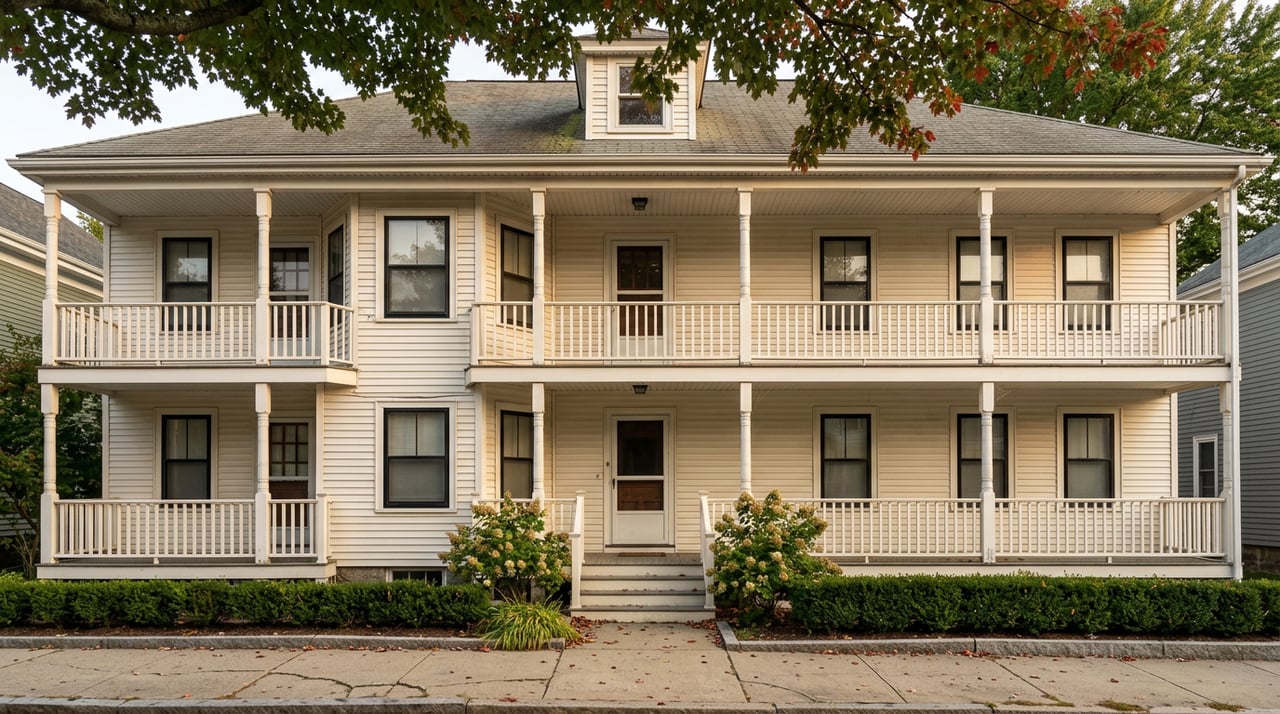
A buyer touring a two-family near Central Avenue this spring asked her agent a fair question: could the building next door turn into a four-unit rental by next year? Versions of that question followed Milton buyers through most of 2024 and 2025, while the town fought the state over multi-family zoning near its trolley stops. The fight is over now. It ended more than a year ago. But the zoning that came out of it covers a smaller, more specific footprint than the headlines during the fight ever made clear, and a lot of buyers are still shopping with the wrong map in their heads.
If you're comparing Milton to Quincy, Braintree, or another Boston suburb, the useful mental model isn't "the whole town rezoned." It's a boundary line, and most of Milton sits outside it.
The six districts that actually changed
In June 2025, Milton's Town Meeting passed zoning that brought the town into compliance with the state's MBTA Communities Act. That zoning created what the town calls the MBTA Communities Multi-family Overlay District, and it covers 158 acres split across six named subdistricts, each with its own rules.
| Subdistrict | Roughly where | What's allowed by right |
|---|---|---|
| Eliot Street Corridor | Along the trolley line | Multi-family buildings of up to 3 units per lot on parcels of 7,500 square feet or more |
| Milton/Central Avenue Station | Around the Central Avenue trolley stop | A required residential component plus restaurants, offices, personal services, and small-scale maker space |
| Mattapan Station | At the trolley's Mattapan terminus | Mixed residential and commercial use tied to the station |
| Blue Hills Parkway Corridor | Near Mattapan Station along the parkway | Multi-family housing up to 30 units per acre on parcels of 7,500 square feet or more |
| Granite Avenue | East Milton, near the Neponset River | Multi-family housing, on the district planners fought hardest to shrink during 2025 negotiations |
| East Milton Square | East Milton's commercial center | A required residential component plus restaurant, office, and personal-service uses, alongside a separate town effort already underway to add its own mixed-use overlay |
Milton has roughly 9,844 housing units townwide. The overlay's 158 acres is a narrow slice of that. Everything outside the six boundaries above, including the large-lot streets that carry much of the town's highest-priced inventory, kept the zoning it had before the law passed. If a listing isn't inside one of those six districts, this law didn't touch it.
Three years, compressed
The underlying law dates to 2021, when the state required every community served by the MBTA to zone for multi-family housing by right near transit. Suffolk University law professor John Infranca has described it as "a modest intervention in local zoning and one that retains significant local control," which is a useful way to think about why compliance looks so different from town to town.
Milton's version of that intervention got contentious fast. Town Meeting approved a compliance article in December 2023. Voters overturned it in a February 2024 townwide referendum, by a 56 to 46 percent margin, making Milton the first community to reject the law outright. The state's Attorney General sued. In January 2025, the Supreme Judicial Court ruled the law constitutional and confirmed the Attorney General's authority to enforce it, though the court also found the state's original implementation guidelines were rolled out improperly. Milton went back to its Planning Board, built a new plan, and passed it at a Special Town Meeting on June 17, 2025, by a 69 to 31 percent vote. A 2026 effort to put a statewide repeal question on the November ballot did not collect enough signatures by the December 2025 deadline, so the law stands.
The math the town published that undercuts the fear
Here's the number that should have driven the coverage and mostly didn't. Milton's zoning creates theoretical capacity for 2,461 multi-family units, which is 25 percent of the town's existing housing stock. That's the number that alarmed a lot of residents and buyers.
But zoned capacity isn't a construction forecast. Milton's own planning analysis puts the realistic net-new unit ceiling at 1,733, because much of the overlay sits on parcels that already have housing on them, and redevelopment only happens when it pencils out for the owner of that specific parcel. The town's own survey of property owners inside the rezoned area found that 86 percent said they would not redevelop under the new zoning. Town planners themselves have said it's unlikely Milton will ever reach even the 1,733 figure, because that would require nearly every eligible owner to tear down and rebuild.
That's the gap worth sitting with. A law that technically permits 2,461 new units is not the same as a market that's about to deliver anything close to that number, because the incentive to redevelop belongs to individual owners, and most of them, by their own account, don't have it right now.
A stranger story sitting in this year's sales numbers
Townwide, Milton's market hasn't shown any sign of the rezoning depressing values. Over the three months ending May 2026, the town's median sale price was $1.0 million, up 3.5 percent from the same period a year earlier, with homes averaging 20 days on market compared to 18 days the year before. Separately, average home value across Milton stood at $1,110,941 as of June 2026, up 2.3 percent year over year. Sales volume did soften some, with 48 homes sold in May 2026 against 55 the year before, but prices held.
Zoom into the Milton Center submarket, the area closest to the town's commercial core and the rezoned overlay, and the picture looks very different. Over the same three-month window ending May 2026, Milton Center's median sale price was $937,000, down 22.5 percent year over year, with homes taking 22 days to sell versus 17 the year before. Only 8 homes sold there in May 2026, down from 15.
An eight-sale month is thin enough that a single distressed sale, a small starter condo, or one investor buying a fixer-upper at a discount can swing a median by 20 percent without reflecting any broader shift in value. It's also possible some of those sales were investors specifically targeting parcels inside the overlay, buying at a discount now with an eye toward the by-right multi-family rights those parcels carry. Both explanations are plausible from the numbers available. The one explanation the data doesn't support is a townwide collapse in value, because townwide values simply didn't move that way.
What to actually check before you write an offer
The most useful five minutes you can spend on a Milton listing is checking it against the town's own zoning map. Milton maintains a public GIS tool that shows the exact boundaries of the six subdistricts, and it's the fastest way to confirm whether a specific address sits inside the overlay or outside it.
If single-family character on your future block matters to you, confirm the address falls outside all six subdistricts. If you're weighing a property partly because of its future redevelopment upside, confirm which subdistrict applies and read its specific rule, since Eliot Street's 3-unit cap and Blue Hills Parkway's 30-units-per-acre standard are very different bets. And know that inside the overlay, qualifying multi-family projects proceed by right, meaning they don't require the special permit hearing that a comparable rezoning would trigger in most other Massachusetts towns.
Common questions from Milton buyers
Does this zoning affect homes outside the six subdistricts? No. Zoning outside the mapped overlay is unchanged by the MBTA Communities Act.
Is the zoning fight still active? Milton reached compliance in June 2025 after the state's highest court ruled the law enforceable. A 2026 statewide repeal effort failed to gather enough signatures to reach the ballot, so the current zoning stands.
Could a property inside the overlay be redeveloped without a public hearing? Qualifying projects inside the overlay can proceed by right, without a special permit hearing, as long as they meet the density, height, and use standards written into that specific subdistrict.
Zoning maps are a starting point, not the whole picture, and the same address can look very different depending on lot size, existing structures, and which of Milton's six subdistricts it happens to sit in. If you're weighing a Milton property and want someone to check the boundary line and the numbers before you make an offer, Boston ONE Realty Group can walk through it with you and get your instant home valuation started at the same time.